
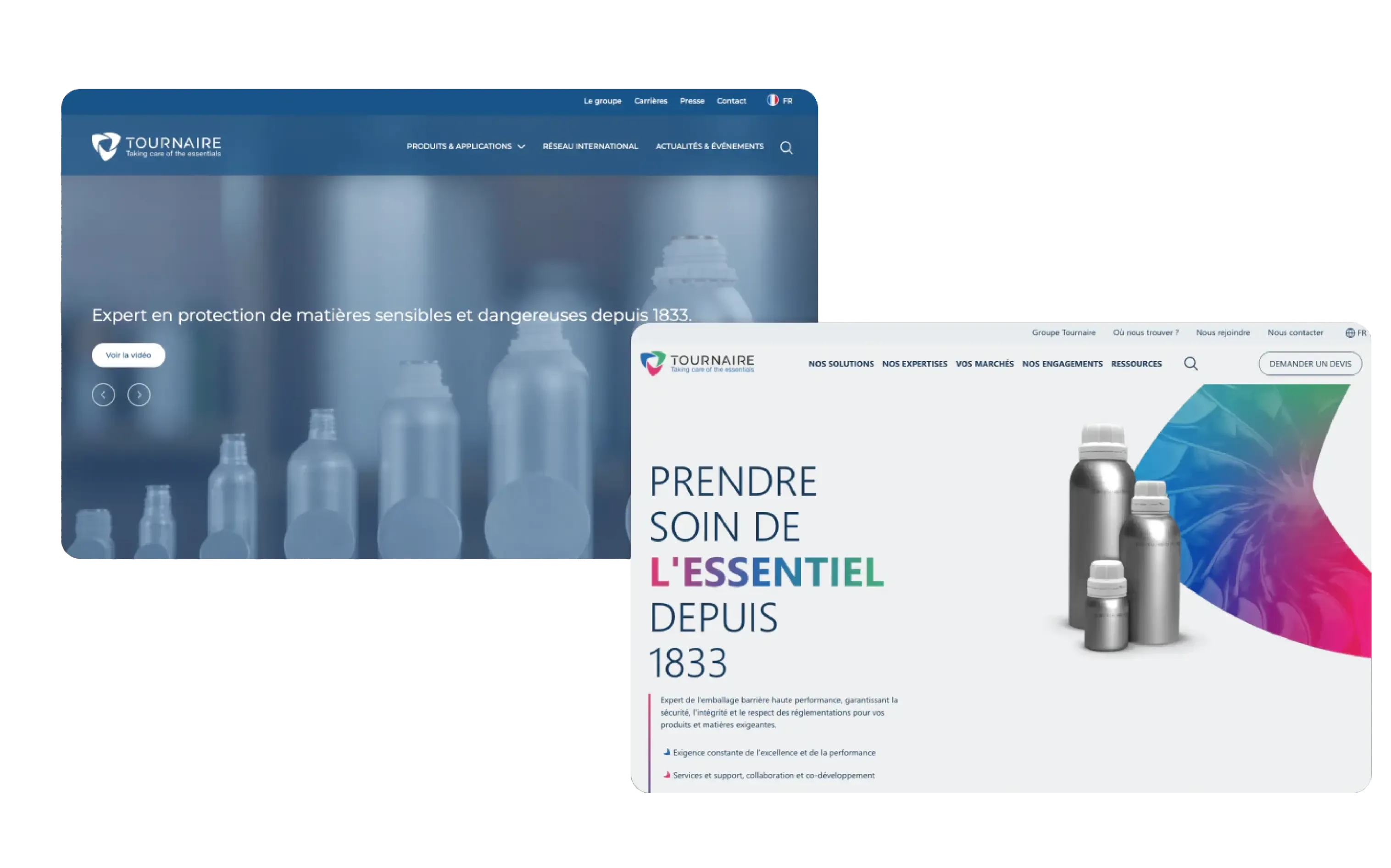
Reducing the carbon footprint of digital
In line with our commitment to taking care of what matters most, we designed the new Tournaire website with a clear objective: reducing the carbon footprint generated by our online presence.
This challenge is far from insignificant. Today, digital technologies already account for 4.4% of France’s carbon footprint, according to the latest study by ADEME, a figure that highlights the very real environmental impact of digital usage.
It therefore seemed essential to apply an eco-design approach to our website, consistent with our industrial and environmental vision.
An eco-designed website at every stage
Eco-designing a website goes far beyond a few technical optimizations. It means considering environmental impacts at every stage of its lifecycle: from specifications to functional and visual design, through development, maintenance and hosting, all the way to end use. It is therefore a true way of thinking and working.
This commitment led us to make concrete choices to limit the resources required to load and use the website, while maintaining a smooth, clear and efficient user experience.
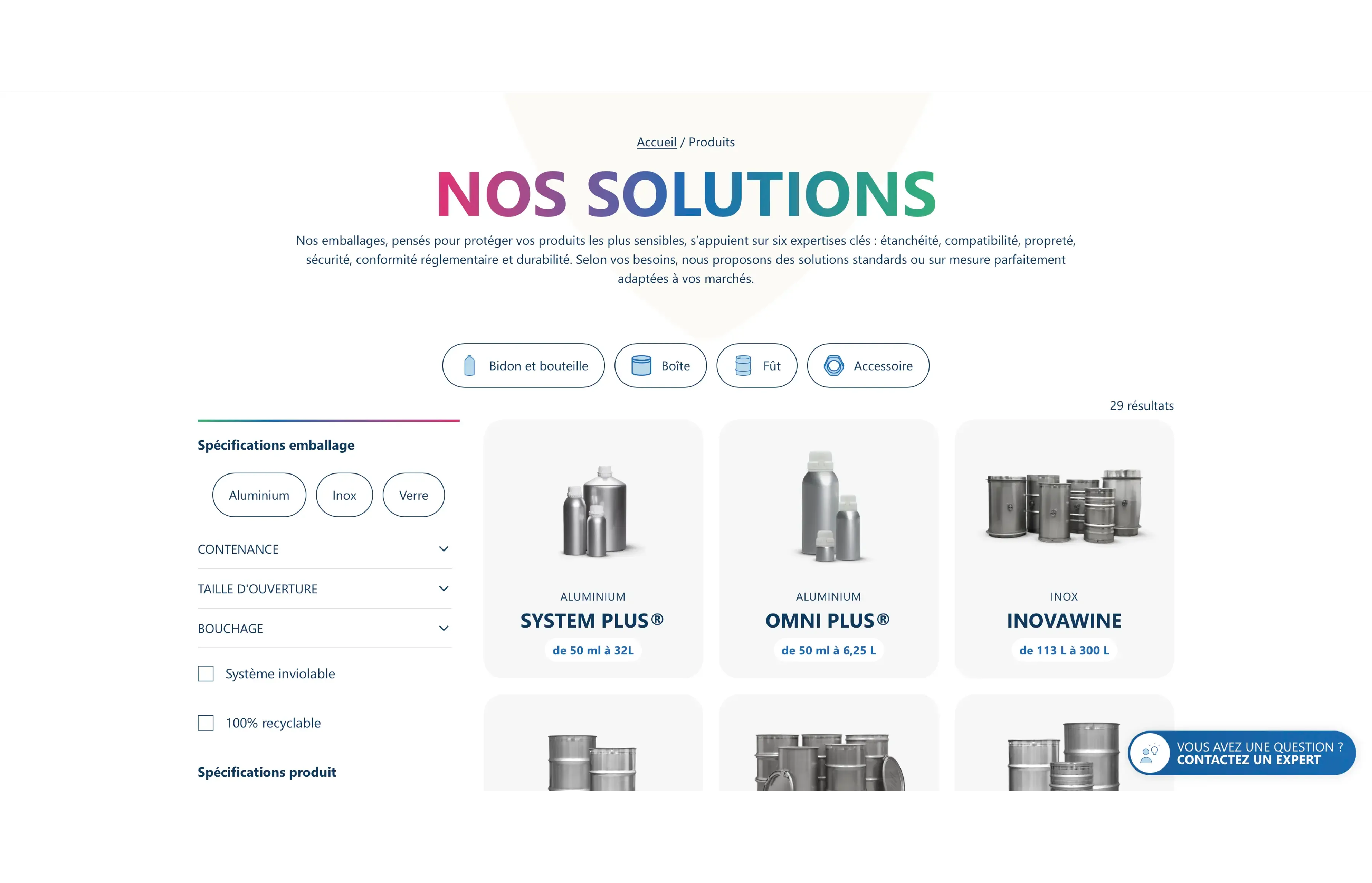
Significant work was carried out on UX to simplify access to information and effectively guide each user in their search. Product listing pages were designed with efficient filters, enabling relevant solutions to be recommended based on specific needs. An advanced search engine was also developed to facilitate the identification of packaging solutions by range, material (aluminium, stainless steel, glass) or application market (perfumery, healthcare, chemicals, etc.).
The objective was to strike a balance between reducing environmental impact and ensuring usability, in order to meet the expectations of our clients and partners.
We chose to host the Tournaire website in France with Datacampus. This company operates using 100% renewable energy, without relying on fossil fuels under normal conditions, and implements technical solutions such as immersion cooling, geothermal air systems, heat recovery and extended hardware lifecycle management.
This choice of hosting in France also makes sense from a climate perspective: Datacampus highlights that the French electricity mix, largely based on nuclear and renewable energy, emits on average 6 to 8 times less CO₂ per kilowatt-hour than countries such as the United States.
Eco-designing a website also means considering its entire technical environment, from design to hosting.
Lighter pages focused on what matters most
We worked on reducing page weight, with particular attention to structure, content hierarchy and the number of media assets. This required certain trade-offs, particularly regarding the use of space on some pages, in order to maintain the desired balance.
This approach also enhances user experience: lighter pages load faster, enable smoother navigation and provide easier access to information, even under variable connection conditions.
Images were compressed using appropriate formats without compromising the digital experience. The number of typefaces was limited, and icons were prioritized in lightweight SVG vector format, supporting our commitments.
Digital sobriety: concrete choices for an eco-designed website
Certain elements commonly found on traditional websites were deliberately excluded: no carousels, no autoplay videos, and a page structure designed to focus on essentials and enable quick access to information with improved content clarity.
We also chose to use photographs produced internally at Tournaire rather than AI-generated visuals, ensuring consistency with our approach to reducing the environmental impact of digital technologies. Website translations were carried out by employees and partners, without relying on integrated automatic translation tools. Beyond quality and accuracy, this choice also helps limit the use of resource-intensive technologies.
Indeed, it is important to note that generative AI tools such as ChatGPT or Midjourney have a significant environmental impact. Their operation relies on energy-intensive data centers, whose development is accelerating worldwide. As a result, the International Energy Agency (IEA) forecasts an increase of more than 75% in their electricity consumption by 2026.
In this context, our approach is not to exclude these tools, but to use them thoughtfully. We prioritize targeted, high-value uses while avoiding systematic reliance when more resource-efficient alternatives exist.
Measuring progress with Eco Index
We chose to calculate the Eco Index of each page on our website and display it in the footer, in order to raise awareness among visitors about responsible digital practices and make our commitment to progress visible.
This indicator is calculated page by page and assesses the environmental performance of a URL based on several criteria, including DOM complexity (Document Object Model, representing the structure and elements of an HTML page), data transfer weight and the number of HTTP requests.
The results clearly reflect this ambition: an improved EcoIndex score, rising from D (53/100) for our previous website to B (75/100) for the new version. The homepage weight has been divided by 9, from 5.42 MB to 0.587 MB, and the website achieves an 82% compliance rate with the reference framework developed by the consulting agency, including RGESN criteria.
Compared to the previous version of our website, for 10,000 monthly visits, this approach enables average annual savings of:
648
Liters of blue water , equivalent to approximately 27 four-minute showers.
432
KgCO₂e , equivalent to around 2,700 km driven by car.
Transparency and continuous improvement
Within an eco-design approach, not all pages have the same environmental impact, as they serve different purposes. Simpler, lighter pages focused on essentials naturally achieve better results. Conversely, more complex pages that include additional interactions or search tools have a higher impact.
This is the case, for example, with the “Our products” page, which has a D rating. This result does not reflect a lack of attention to eco-design, but rather a deliberate balance between digital sobriety and user experience. On this page, we prioritized simple, clear and effective filters to facilitate product search. Further optimization would have required reducing useful functionalities, potentially degrading the user experience.
We believe it is important to explain this reality: an eco-designed website is not uniform, nor does it mean that all pages achieve the same rating. Demonstrating that simpler pages perform better, while more complex ones score lower, helps users understand the value of this approach and raises awareness about the environmental impact of digital usage. It also encourages more responsible behaviors by guiding users toward simple, efficient and relevant journeys.
The eco-design of the Tournaire website is part of a broader digital strategy aimed at taking care of what matters most, based on a balance between user experience and environmental responsibility.
Each decision reflects a commitment to taking concrete action, while remaining aware of the necessary trade-offs required to uphold our standards.
Julie VIALE,
and the Tournaire teams